
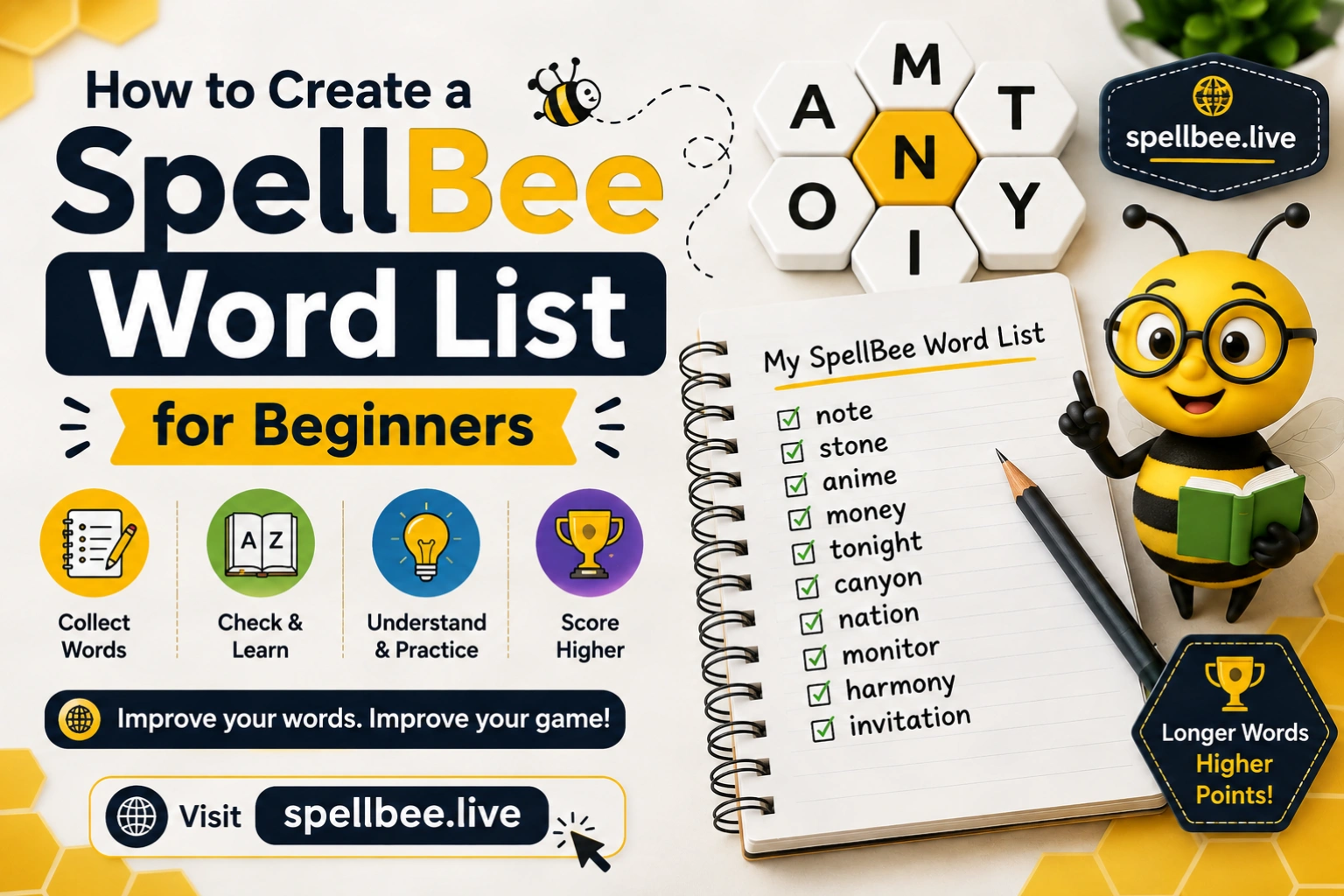
Finding new words in a SpellBee puzzle can be tricky, especially when you are starting out. You may look at the seven letters and still miss words that are right in front of you. The problem is often not your vocabulary. You may need more practice with letter patterns and word combinations. Creating a spellbee word list is a simple way to improve. You can save difficult words, words you miss during a game, and new words you discover while playing. Looking at these words later can help you remember them. It also makes it easier to find similar words. You do not need hundreds of words to begin. A small, handy word list can boost spelling, expand vocabulary, and help find words during a game.
Start with simple words and then introduce more complex ones. Save words you miss, new pangrams, and unfamiliar words. Check new words in a trusted dictionary, then review your list often to remember them better.
What Is a SpellBee Word List?
A SpellBee word list is a collection of words you wish to learn and practise. You can keep it in a notebook, on your phone, or in a document on your computer.
There is no special format you need to follow. Your list should be simple enough to use whenever you want to practise. You can write the word first and add a short note if there is something difficult about its spelling or meaning.
A useful list can include:
Short words
Medium words
Long words
Difficult words
New words
Words you missed during a game
Pangrams
The best part is that you can build your list from your own games. This means the words you practise are words that you have actually seen and found useful.
Why Is a Word List Helpful?
A word list gives you an easy way to practise outside the game. When you find a new or difficult word, writing it down gives you a chance to review it later instead of forgetting it.
It can also help you notice common spelling patterns. Seeing similar letter groups in different words can help you recognise them faster.
A word list can help you.
Improve your spelling
Learn new words
Build your vocabulary
Remember difficult spellings
Notice common word patterns
Find words faster
Prepare for future games
Building vocabulary is useful beyond word games too. The more English words you know, the easier it is to read, write, and grasp new ones.
Start With Easy Words
If you are new to spellbee, start with words that are easy for you. There is no need to begin with the hardest words you can find.
The game uses seven letters, including one center letter. You must use the centre letter in every word, and each word needs at least four letters. Understanding these basic rules makes it easier to start building words.
Begin by looking for simple words that use the center letter. Once you're used to those words, try finding longer ones and rarer combinations.
Starting with easy words can also help you understand how letters work together. As your skills improve, your word list can become more challenging.
Group Words by Length
Grouping words by their length can make your word list easier to use. It also helps you identify the types of words you find with ease and the ones that need more practice.
You can find short words with ease, while longer words may need more thought. Practising both types is useful because they have different roles in the game.
SpellBee scoring also makes word length important. A four-letter word gives 1 point, while words longer than four letters give 1 point for each letter. For example, a five-letter word gives 5 points and a six-letter word gives 6 points.
Because of this, your list should not contain only long words. Keep a good mix of short, medium, and long words so you can practice different ways of building your score.
Learn Common Spelling Patterns
English has many words that use similar groups of letters. Learning these patterns can make spelling and word finding easier.
For example, you may notice endings such as:
-ing
-ed
-er
-ness
-tion
-ment
You may also notice beginnings such as un-, re-, pre-, and dis-.
We call these word parts prefixes and suffixes. A prefix usually comes at the beginning of a word, while a suffix usually comes at the end.
You do not need to memorise every prefix and suffix at once. Instead, notice them while you read and play. When you find a useful pattern, add a few words that use it to your list.
This can help you recognise familiar letter groups when you see them in a new word.
Add Words You Miss During a Game
One of the best ways to create a useful word list is to learn from your own games. After playing, think about the words you could not find.
There was a longer word that you did not notice. You knew a word but forgot how to spell it. You may also find a word that you have never seen before.
These are exactly the types of words that belong in your list.
For example, if "beautiful" is difficult to spell, write it down and pay attention to the eau in the middle. You can practise the word a few times and then try to spell it without looking.
When you build your list this way, every word has a reason for being there. You are learning from your own mistakes rather than memorising random words.
Check New Words in a Dictionary
Sometimes a word may look unfamiliar, even if you have seen it in a game. Before adding it to your list, check its spelling and meaning.
A trusted dictionary such as Merriam-Webster can help you understand a new word. The Oxford English Dictionary can help you learn new English words and what they mean.
A dictionary can help you check:
Correct spelling
Word meaning
Pronunciation
Example usage
Different forms of a word
Learning the meaning of a word can make it easier to remember. Instead of seeing it as a random group of letters, you understand what the word means and how it is used.
Make a Separate Pangram List
Pangrams deserve a special place in your SpellBee word list. A pangram is a word that uses all seven letters in the puzzle at least once.
A pangram can be harder to find than a short word because it must include every letter. This makes pangrams a fun challenge for players who want to find more words.
Create a small section called Pangrams to Practice. Whenever you find a new pangram, add it there and review it later.
Pangrams relate to game achievements like First Pangram and Pangram Pro. This gives you another reason to keep practicing them.
Do Not Make Your List Too Big
It can be tempting to add hundreds of words when you first start. However, a very large list can become difficult to review.
Start with around 20 to 30 useful words. Spend some time learning these words before adding many more. Once you know most of them, you can slowly grow your list.
The goal is not to have the biggest list. The goal is to have a list that you actually use.
A small list that you review regularly can be more useful than a huge list that you never open.
Review Your List Often
Writing a word down is only the beginning. You also need to review it if you want to remember it.
Spend a few minutes with your list every few days. Read the words first, then cover them and try to spell them from memory.
You can also practice by:
Writing words without looking
Saying words out loud
Testing yourself with five words
Practicing words you often forget
Grouping words with similar spellings
If you make a mistake, do not worry. Look at the word again and try it later. Repeating difficult words can make them easier to remember.
Make Word Practice Fun
Learning new words does not have to feel like homework. You can turn your word list into a small game.
Choose five words and hide their spellings. Then try to write them from memory. Afterward, check your answers and see how many you got right.
You can also choose words that have something in common. For example, find words that have the same ending or contain a similar group of letters.
This practice helps you learn and keeps things simple and fun.
Do Not Learn Only Hard Words
It may seem like hard words are the most useful, but easy words are important too. During a game, finding simple words quickly can give you more time to look for longer words.
Longer words can give more points, but that does not mean short words should be ignored. A good player should feel comfortable with different word lengths.
Try to keep a mixture of:
Easy words
Medium words
Long words
Difficult words
Pangrams
This gives you a balanced word list and helps you practise different parts of the game.
Keep Track of Your Progress
Keeping track of your progress can make your practice more rewarding. You can make a simple table and mark a word when you feel confident in spelling it.
Replace the example words with words from your own practice.
When you can spell a word without looking, mark it as learned. If you still have trouble with it, leave it for another practice session.
This simple method can help you see how your word knowledge grows over time.
Use Your SpellBee Games for Practice
Your own games can be one of the best sources for your word list. Each game gives you a chance to discover new words and notice the words that are difficult for you.
After a game, take a few minutes to think about what happened. Which words did you miss? Which words were difficult to spell? Did you discover a new word?
Write the useful ones in your list and review them later.
This makes your practice more personal. You are making your own word list instead of copying one from somewhere else.
Over time, words that once looked difficult may become much easier to recognise.
Common Mistakes to Avoid
A common mistake is adding too many words at once. A long list may be difficult to review, so start with a few words and gradually increase the number.
Another mistake is choosing only hard words. Easy words are useful too, particularly when you need to find words in a short amount of time during a game.
Some beginners also write words down but never review them. Try to return to your list regularly so the words stay fresh in your memory.
It is also better to avoid adding random words just to make your list bigger. Choose words that are new, difficult, useful, or interesting to you.
A Simple Word List Routine
Creating a word list can become part of your normal SpellBee routine. Start by playing a game and paying attention to the words you find.
After the game, choose a few words that were difficult or new. Write them down and check their meanings if you do not know them. If you find a pangram, save it in your pangram section.
After a few days, return to your list and test yourself. Try to spell the words without looking. Keep practicing the words that are still difficult and add new words as you continue playing.
With this simple routine, your word list can grow and help you learn new words.