
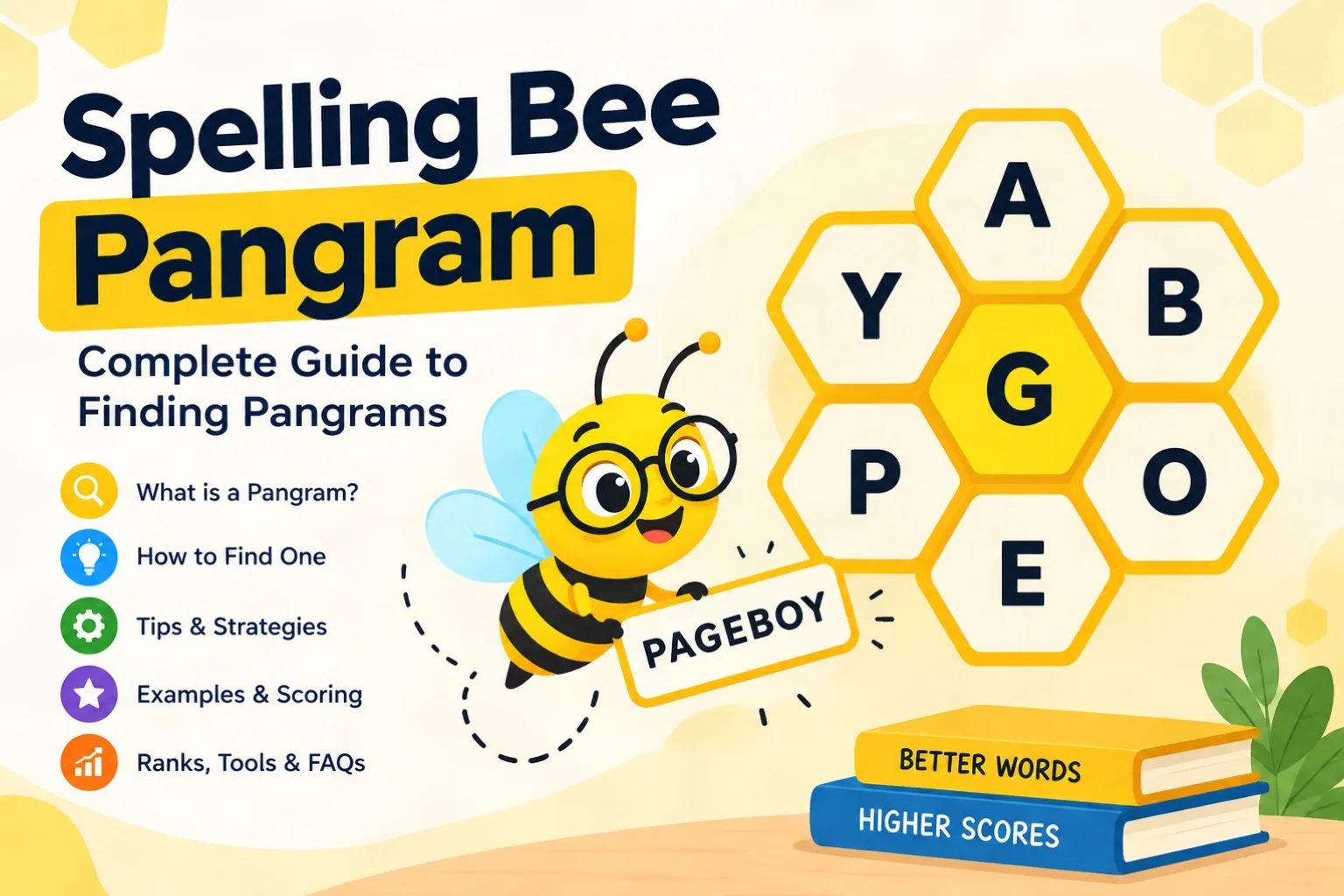
Have you ever found almost every word in a Spelling Bee puzzle, but still felt like one word was missing? It could be the pangram. A pangram is a word that uses all seven letters in the hive. Finding one is always a great moment because it can add valuable points to your score.
The hard part is finding that word. You may look at the same seven letters again and again and still miss it. But once you know a few simple patterns, it becomes easier to spot possible pangrams.
So, what makes a pangram special, and how can you find one more easily? Let’s start with the basics.
What Is a Pangram in Spelling Bee?
A pangram is a word that uses all seven letters in a Spelling Bee puzzle. You must use the center letter, and you can reuse any letter as many times as needed. Finding a pangram is thrilling. It can boost your score and help you reach higher ranks.
Definition of a Pangram
A pangram is a word that contains every letter from the seven-letter hive at least once. The center letter must be part of the word, like it is for every valid Spelling Bee word.
You can also reuse letters, so a pangram does not have to contain each letter only once. Some pangrams are easy to spot, while others can be harder to recognize.
Pangram vs. Perfect Pangram
A regular pangram uses all seven hive letters at least once, so some letters can appear more than once.
In a seven-letter Spelling Bee puzzle, a perfect pangram uses each letter exactly once. This makes it much more specific than a regular pangram and much less common.
Does Every Spelling Bee Puzzle Have a Pangram?
Depending on the game and puzzle, a pangram may not always be present. When a puzzle does have one, it may be easy to spot or hidden among many possible words.
A puzzle can also contain more than one pangram, so finding the first one does not always mean you have finished.
Why Pangrams Are Important
Pangrams matter. They use all seven hive letters in one valid answer. This can also help you boost your score.
For many players, finding the pangram is one of the best parts of solving a Spelling Bee puzzle.
How Spelling Bee Pangrams Work
A pangram has to do more than use a lot of letters. It must also follow the basic Spelling Bee rules. Knowing how the center letter and scoring work makes it easier to check a possible answer.
The Center Letter Rule
Every valid Spelling Bee word, including a pangram, requires the center letter.
If a possible answer uses the entire hive but leaves out the center letter, it will not count as a valid word.
Use All Seven Letters
The key requirement of a pangram is simple: the word must include every letter in the seven-letter hive.
The letters can appear in any order, and they can be reused. This means a pangram can be longer than seven letters.
Pangram Bonus and Scoring
Many Spelling Bee-style games award pangrams extra points. This is because they use all the letters in the hive. However, the exact scoring and bonus can vary depending on the game.
Check pangrams, longer words, and other valid answers to boost your score.
Can a puzzle have more than one pangram?
Yes, a single puzzle can have more than one pangram. Each possible answer still needs to follow the same basic rules.
Keep looking for other word combinations. Don't assume you've found the only answer.
How to Find a Pangram in Spelling Bee
Finding a pangram becomes easier when you stop trying to guess the whole word at once. Instead, look for familiar beginnings, endings, word families, and letter patterns.
Look for Common Prefixes and Suffixes
Check the hive for letters that can form common prefixes and suffixes. Familiar endings such as -ing, -ed, -er, or -ly can help you build longer words.
Once you find a possible ending or beginning, test the other letters around it. You may discover a word that brings the full hive together.
Build Word Families
When you find one useful word, try changing its beginning or ending to make related words. These word families can reveal longer possibilities that you might otherwise miss.
This is especially helpful when many words have a similar structure but use different letters from the hive.
Look for Double-Letter Patterns
Some words contain repeated letters such as “ll,” “ss,” or “ee.” These patterns can give you another way to explore the hive.
If the letters show a common double-letter pair, try making a word with it. Then see if you can use the other letters.
Try Compound Words
Compound words combine two smaller words into one longer word. When the hive contains useful combinations, checking for compound patterns can give you new options.
Check common word pairs and see if you can make them with the letters from the hive.
Look for Common Vowel Patterns
Vowels can provide useful clues when a pangram is difficult to spot. Look at how the available vowels might fit together with the consonants.
Common vowel combinations can make an unfamiliar-looking word easier to recognize.
Shuffle the Hive to Find New Patterns
Sometimes the letter order makes a puzzle look more difficult than it is. Use the shuffle option to rearrange the hive and view the letters differently.
A new letter order can help you spot word beginnings, endings, or combinations you might have missed.
Start With Short Words and Expand
Short words can help you understand how the letters work together. Once you find a useful combination, try extending it into a longer word.
Look at the letters you have not used yet and see whether they can fit into the same word structure. This gives you a more focused way to search for a pangram.
Spelling Bee Pangram Strategies That Work
The right strategy can make pangrams easier to spot. Use a clear search order. Focus on patterns that often show up in words, instead of trying random combinations.
The Suffix-First Approach
Start by looking at possible word endings. Common suffixes such as -ing, -ed, -er, and -ly can give you a useful starting point.
Once you find an ending for the hive, start from there. Test various beginnings until you discover a word that uses the right letters.
The Prefix-Mining Method
You can also search from the beginning of a word. Prefixes such as un-, re-, dis-, and pre- may help you create possible word structures.
If you find a useful prefix, add different letters. Then see if the new word can cover the whole hive.
The Systematic Search Method
When patterns are not enough, search the hive in an organized way. Begin with familiar words and find the missing letters in each option.
Then focus on those missing letters instead of trying random combinations. A systematic search keeps your attention on the letters that matter most.
Common Mistakes When Finding Pangrams
Even experienced players can miss pangrams by using the same search method for too long. A few common mistakes can make the puzzle feel harder than it is.
Forgetting the Center Letter
One easy mistake is finding a word that seems to use the whole hive but does not contain the center letter.
Always check the center letter before accepting a possible pangram. If it is missing, the word cannot be a valid answer.
Focusing Only on Short Words
Short words are useful at the beginning, but they may not lead directly to the pangram. If you focus only on four- or five-letter words, longer possibilities can be easy to miss.
Use the words you have already found as clues for exploring longer word structures.
Assuming Pangrams Must Be Long or Difficult
A pangram does not have to be a long or unusual word. Sometimes a familiar-looking word can use the full hive.
Do not reject a possible answer because it seems simple. Check its letters before moving on.
Giving Up Too Early
Some pangrams take time to recognize. If you don’t find one right away, try a different search method instead of making the same guesses.
Go back to your known words and test different prefixes, suffixes, and combinations.
Pangram Examples in Spelling Bee
Different pangram patterns can make the idea easier to understand. Some are simple to recognize, while others can stay hidden until you look at the hive from a different angle.
Common Pangram Examples
A common pangram is simply a valid word that brings together all seven letters of the hive. Players often look for shorter answers, so these words can be easy to miss.
When looking at your possible words, notice longer ones that mix familiar patterns.
Rare Perfect Pangrams
A perfect pangram in a seven-letter puzzle is highly specific. Each letter appears only once.
This is a much stricter pattern than an ordinary pangram, so it is not something you should expect to find often.
How Often Do Pangrams Appear?
The number of pangrams can vary from puzzle to puzzle. Some puzzles may have one, while others can have several.
The letters and possible words differ with each puzzle. So, there’s no one number that fits all Spelling Bee puzzles.
How Pangrams Help You Reach Genius and Queen Bee
Pangrams can help you boost your score and reach higher ranks. They bring all the hive's letters together in one answer. They can also add useful points based on the game's scoring system.
Spelling Bee Scoring and Points
Every valid word adds to your Spelling Bee score according to the game's scoring rules. Longer words can often be worth more, while pangrams may be worth more.
Finding pangrams and other valid words can boost your score and help you rank higher.
Reach Genius Rank
Genius is a high Spelling Bee rank that requires you to earn enough points from valid words. Finding pangrams can help you reach this rank because they add valuable points to your score. If you are close to Genius, look for a pangram before giving up. One missed pangram can sometimes provide the extra points you need.
Queen Bee Rank
Queen Bee is a top Spelling Bee achievement that requires finding all the valid words in a puzzle. Pangrams are an important part of reaching this goal because you need to find every accepted word, not just the pangrams. Finding one pangram does not mean you are finished. Keep checking the hive for other words you may have missed.
Why Pangrams Are Worth Finding
Pangrams are great to find. They can boost your score and show you've used all seven letters in the hive.
They’re also great for improving your puzzle-solving skills and climbing the ranks.
Helpful Spelling Bee Pangram Tools
Sometimes you can find most of the words but still get stuck on the pangram. You can use some simple tools to check possible words, explore letters, and find missed words.
The best approach is to use these tools as a learning aid rather than relying on them for every puzzle.
Free Pangram Finder Tools
A pangram finder can help when you are stuck and cannot find the missing word. These tools check the available letters and show possible words that use the full set.
They can also help you learn new Spelling Bee word patterns. For better practice, try solving the puzzle yourself before checking a finder.
Spelling Bee Word Lists
Spelling Bee word lists can help you learn which words commonly appear in word puzzles. They are useful for building vocabulary and recognizing patterns.
You can study prefixes, suffixes, word families, and different letter combinations. Over time, these patterns can become easier to recognize during a new puzzle.
How to Use a Solver Without Losing the Fun
A Spelling Bee Solver can be useful when you are stuck. Try solving the hive on your own first. Only use the solver for words you can't find.
This approach lets you learn from the answers rather than simply copying them. Look at the word patterns. This way, you can spot similar options in future puzzles.